



ResearchCollaborations
Collaborations are an integral part of research at the BDR. The Center has a range of different schemes in place to further promote collaborative research within BDR as well as with external organizations, including industry.
BDR Center Projects
BDR brings together researchers with diverse areas of expertise. Building on this strength, BDR promotes “Center Projects” to foster collaboration across laboratories and research fields. Under a shared research theme, researchers with different knowledge, technologies, and perspectives work together and combine their expertise to open up new avenues of research and generate greater scientific impact.
TransitionCode Project
The TransitionCode Project aims to uncover the mechanisms underlying major changes in the states of multicellular biological systems, or “stage transitions,” that occur during development, growth, and aging. To achieve this, the project will develop a new technological framework for integrated measurement and analysis across time and space, bringing together information at multiple levels—from molecules and cells to tissues and whole organisms—as well as data on gene activity and the forces acting on cells and tissues. By identifying common principles underlying stage transitions that occur over different timescales, the project ultimately seeks to predict and control these transitions.
Project Leader: Ichiro Hiratani
AX Biology Project
Named for the AI-driven transformation of the life sciences, the AX Biology Project aims to establish a new mode of biological research that draws fully on AI and data. The project is building a distinctive platform that integrates three technologies underpinning BDR's research competitiveness: AI, data management, and laboratory automation. By making research both more efficient and more advanced, this platform is designed to drive high-impact results.
Project Leader: Koichi Takahashi
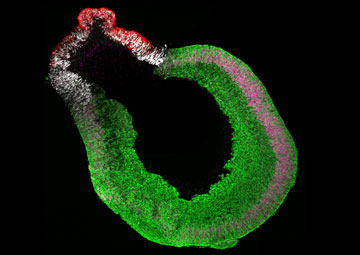
The Organoid Project advances technologies for generating and culturing organoids—three-dimensional, organ-like tissues produced from human iPS cells and other stem cells. Alongside basic research in developmental and stem cell biology that underpins these technologies, the project will promote collaboration with AI and automation technologies, medicine, drug discovery, and industry, aiming to create an ecosystem in which these areas of research can mutually reinforce one another. By accelerating advances in organoid technologies, the project seeks to contribute to a better understanding of disease mechanisms and to applications in drug development and regenerative medicine.
Project Leader: Minoru Takasato
Life-Cycle Redesign Project
The Life-Cycle Redesign Project explores ways to control the life cycle of organisms, from birth and growth to maturation and aging. The project focuses on processes such as reproduction, biological clocks, metabolism, and communication between organs to identify “modules of life”—manipulable units that drive biological activity. By determining how changes to individual modules affect the body as a whole, the project aims to develop new approaches for selectively enhancing specific biological functions.
Project Leader: Kazunari Miyamichi
Material Code of Life (MCoL) Project
The Material Code of Life (MCoL) Project focuses on the physicochemical material properties of living systems. Biological phenomena are sustained by the physical and chemical properties of cells and tissues, including their viscoelasticity and mechanical responses. However, much remains unknown about how genes, proteins, and metabolites collectively control these material properties. The project will develop technologies to measure the diverse material properties of biological tissues and investigate how these properties emerge from the collective behavior of vast numbers of molecules. It also aims to uncover how these material properties, in turn, regulate biological processes such as development, tissue maintenance, and aging.
Project Leader: Sa Kan Yoo
The overview of the past Center Projects (completed at the end of FY2024).

DECODE Project (Apr. 2019–Mar. 2024)
This project aims to develop DECODE technology to estimate, predict and manipulate the cell states by observing and analyzing images of changing cells using state-of-the-art measurement technology and artificial intelligence.

QMIN Project (Oct. 2019–Mar. 2024)
Torpor is an active hypometabolic state in mammals. The QMIN project will drive torpor research and aim to translate our knowledge of torpor to applications to benefit human society.
Structural Cell Biology Project (Oct. 2019–Mar. 2024)
This project aims to develop technologies to approach complexes and multilayered structures of biological macromolecules and to bridge the gap in knowledge between molecules and cells to further advance our understanding of life.
Research Automation Project (Sep. 2019–Mar. 2024)
This project will develop various automation technologies ranging from experimental robotics, data-processing workflow, and any other topics relevant to scientific projects such as automated experimental designs and hypothesis generation.

Stage Transition Project (Jun. 2020–Mar. 2024)
This project aims to elucidate the mechanisms underlying major, non-linear stage transitions during the life cycle, identify new transitional phenomena, and develop novel theories and technologies to analyze the transitions.
Collaboration Centers
RIKEN actively promotes the transfer of its scientific achievements into commercial products through partnerships with industry. Based on proposals from companies, “Collaboration Centers” are set up within RIKEN to tackle mid- or long-term projects to create innovations and foster human resources with experience working in an environment that blends the cultures of RIKEN and industry.