


Unit Leader
Mikako Shirouzu
Ph.D.
Drug Discovery Structural Biology Platform Unit
[Affiliation has changed to RIKEN Center for Integrated Medical Sciences (IMS) as of April 2025]
Location Yokohama
E-mailmikako.shirouzu@riken.jp
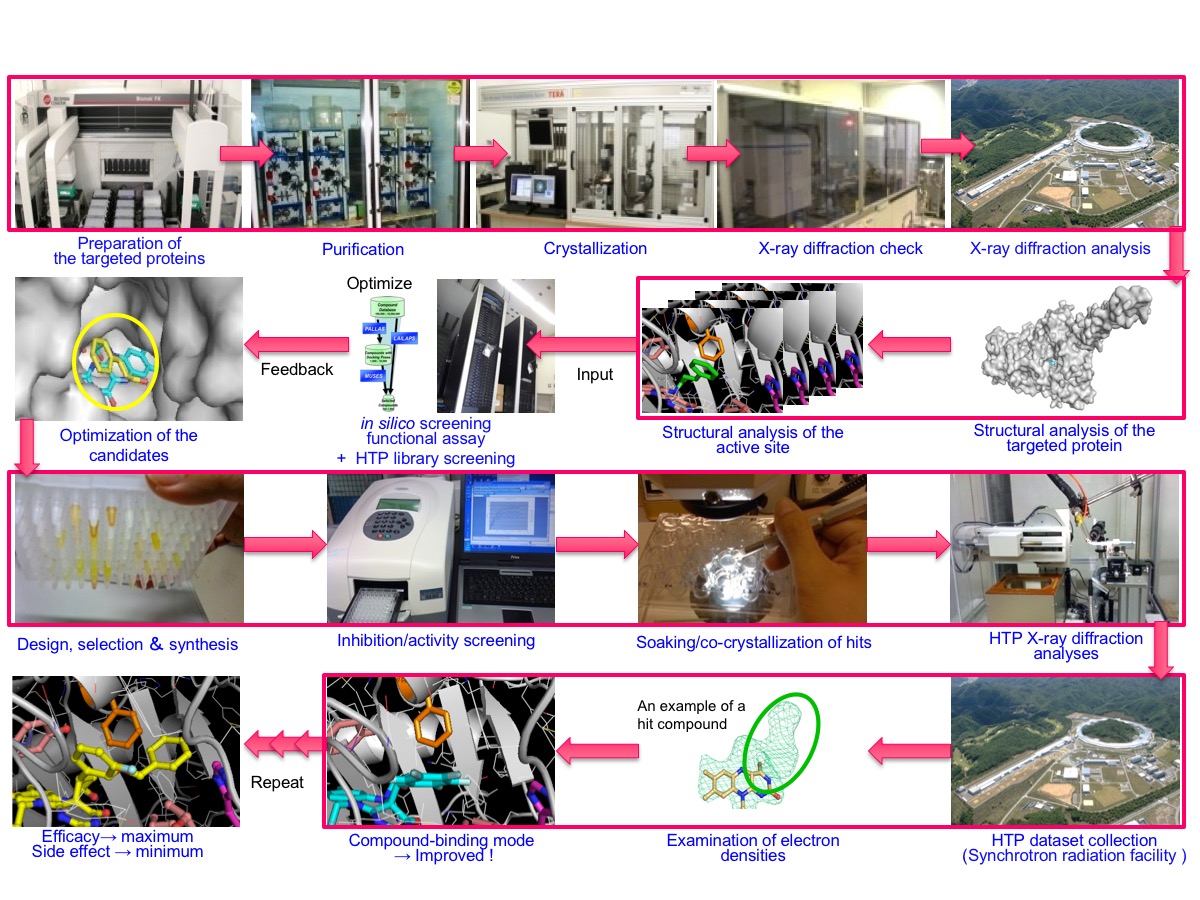
RIKEN Program for Drug Discovery and Medical Technology (DMP) is developing new candidate drugs and technologies for drug discovery and medical treatment. As part of the activities, our unit carries out protein sample preparation, evaluation of candidate compounds in vitro and in a cell-based manner, and structural analysis of their complexes to improve monoclonal antibody drugs, vaccines, and candidate small molecular drugs. Our activities as experts of protein science and cell biology are indispensable for the rational drug development promoted by DMP.
Project
- Preparation of antigen proteins for monoclonal antibody drugs and vaccines
- Preparation of target proteins for candidate compound evaluation and structural analysis
- In vitro compound evaluations for small molecular drugs
- Cell-based compound evaluations for small molecular drugs
- Complex structural analysis for rational drug development
Selected Publications
Takemori T, Sugimoto-Ishige A, Nishitsuji H, et al.
Establishment of a Monoclonal Antibody against Human NTCP That Blocks Hepatitis B Virus Infection.
Journal of Virology
96(5), e0168621 (2022)
doi: 10.1128/JVI.01686-21
Yamamoto H, Sakai N, Ohte S, et al.
Novel bicyclic pyrazoles as potent ALK2 (R206H) inhibitors for the treatment of fibrodysplasia ossificans progressiva.
Bioorganic & Medicinal Chemistry Letters
38, 127858 (2021)
doi: 10.1016/j.bmcl.2021.127858
Mizuta H, Okada K, Araki M, et al.
Gilteritinib overcomes lorlatinib resistance in ALK-rearranged cancer.
Nature Communications
12(1), 1261 (2021)
doi: 10.1038/s41467-021-21396-w
Nara T, Nakagawa Y, Tsuganezawa K, et al.
The ubiquinone synthesis pathway is a promising drug target for Chagas disease.
PLOS One
16(2), e0243855 (2021)
doi: 10.1371/journal.pone.0243855
Takahashi K, Akatsu Y, Podyma-Inoue KA, et al.
Targeting all transforming growth factor-β isoforms with an Fc chimeric receptor impairs tumor growth and angiogenesis of oral squamous cell cancer.
The Journal of Biological Chemistry
295(36), 12559-12572 (2020)
doi: 10.1074/jbc.RA120.012492
Sato T, Sekimata K, Sakai N, et al.
Structural Basis of Activin Receptor-Like Kinase 2 (R206H) Inhibition by Bis-heteroaryl Pyrazole-Based Inhibitors for the Treatment of Fibrodysplasia Ossificans Progressiva Identified by the Integration of Ligand-Based and Structure-Based Drug Design Approaches.
ACS Omega
5(20), 11411-11423 (2020)
doi: 10.1021/acsomega.9b04245
Yasukawa M, Ando Y, Yamashita T, et al.
CDK1 dependent phosphorylation of hTERT contributes to cancer progression.
Nature Communications
11(1), 1557 (2020)
doi: 10.1038/s41467-020-15289-7
Tsuganezawa K, Sekimata K, Nakagawa Y, et al.
Identification of small molecule inhibitors of human COQ7.
Bioorganic & Medicinal Chemistry
28(1), 115182 (2020)
doi: 10.1016/j.bmc.2019.115182
Sekimata K, Sato T, Sakai N, et al.
Bis-Heteroaryl Pyrazoles: Identification of Orally Bioavailable Inhibitors of Activin Receptor-Like Kinase-2 (R206H).
Chemical & Pharmaceutical Bulletin
67(3), 224-235 (2019)
doi: 10.1248/cpb.c18-00598
Tanaka M, Ishige A, Yaguchi M, et al.
Development of a simple new flow cytometric antibody-dependent cellular cytotoxicity (ADCC) assay with excellent sensitivity.
Journal of Immunological Methods
464, 74-86 (2019)
doi: 10.1016/j.jim.2018.10.014